Breath Awareness in Early Recovery: Gentle Practices Alongside Professional Care
Early recovery is rarely quiet. Sleep comes in pieces, the body hums with restlessness, and the mind fills every gap with noise. For many people, the first weeks and months feel like living inside a nervous system that won’t settle.
Breath work won’t fix that on its own, and it isn’t meant to. But gentle breath awareness can offer something small and steady to come back to, alongside the professional support recovery needs.
Why early recovery feels so physical
People describe early recovery in very physical terms: a tight chest, a racing heart, fidgety hands, a body that’s exhausted but can’t rest. Attention to the breath doesn’t change what’s happening in someone’s life, but it can offer a moment of steadiness.
What the research says, and where it’s limited
Yoga, stress and anxiety in general. The US National Center for Complementary and Integrative Health (NCCIH) summarises the research in its Yoga for Health guide (updated August 2024). It says some research indicates that practising yoga can lead to improvements in physical or psychological aspects of stress, and that yoga may help with anxiety linked to life situations, such as coping with a health problem. It is also careful to note that there’s less evidence of a benefit for anxiety disorders, although yoga might be a useful addition to other treatment. This research is mostly not about people in addiction recovery.
Mindfulness alongside addiction treatment. The research here is more specific, and more mixed. A randomised trial published in JAMA Psychiatry in 2014 (Bowen and colleagues) followed 286 people in aftercare after inpatient or intensive outpatient treatment. At 12 months, those who’d taken part in an eight-week mindfulness-based relapse prevention group reported fewer days of substance use and less heavy drinking than those in standard relapse prevention or usual care. A larger Cochrane review in 2021, which pooled 35 trials, was more cautious. It found that mindfulness-based approaches may slightly reduce days of substance use compared with other treatments, but rated the certainty of the evidence as low to very low.
That’s a reason for interest, not a guarantee. The mindfulness programmes studied were delivered by trained facilitators over several weeks as part of structured treatment, not instead of it. That research doesn’t establish that the three brief exercises below improve addiction outcomes on their own; they’re offered as simple ways to find a moment of steadiness, not as treatment.
Three accessible practices
The following practices are gentle and optional. There’s no breath holding and no need to count to any fixed rhythm. If at any point something feels uncomfortable, simply return to natural breathing or stop.
For some people, especially those with experience of trauma or panic, paying close attention to the breath or body can itself feel uncomfortable. If that’s the case for you, try an external focus instead: listen to the sounds around you, near and far, or notice the contact of your feet on the floor and your body on the chair. That’s a perfectly valid way to practise.
1. The lengthened exhale
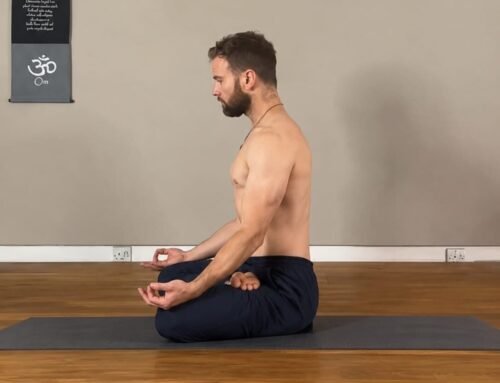
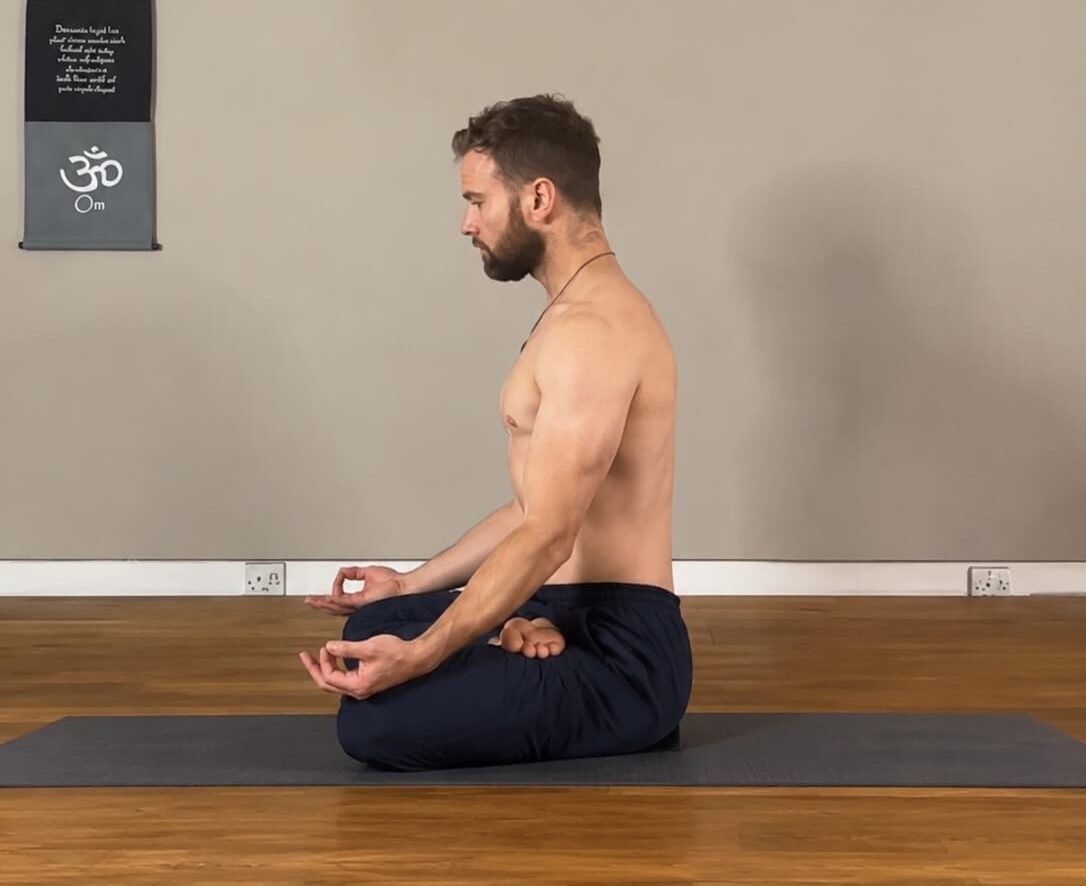
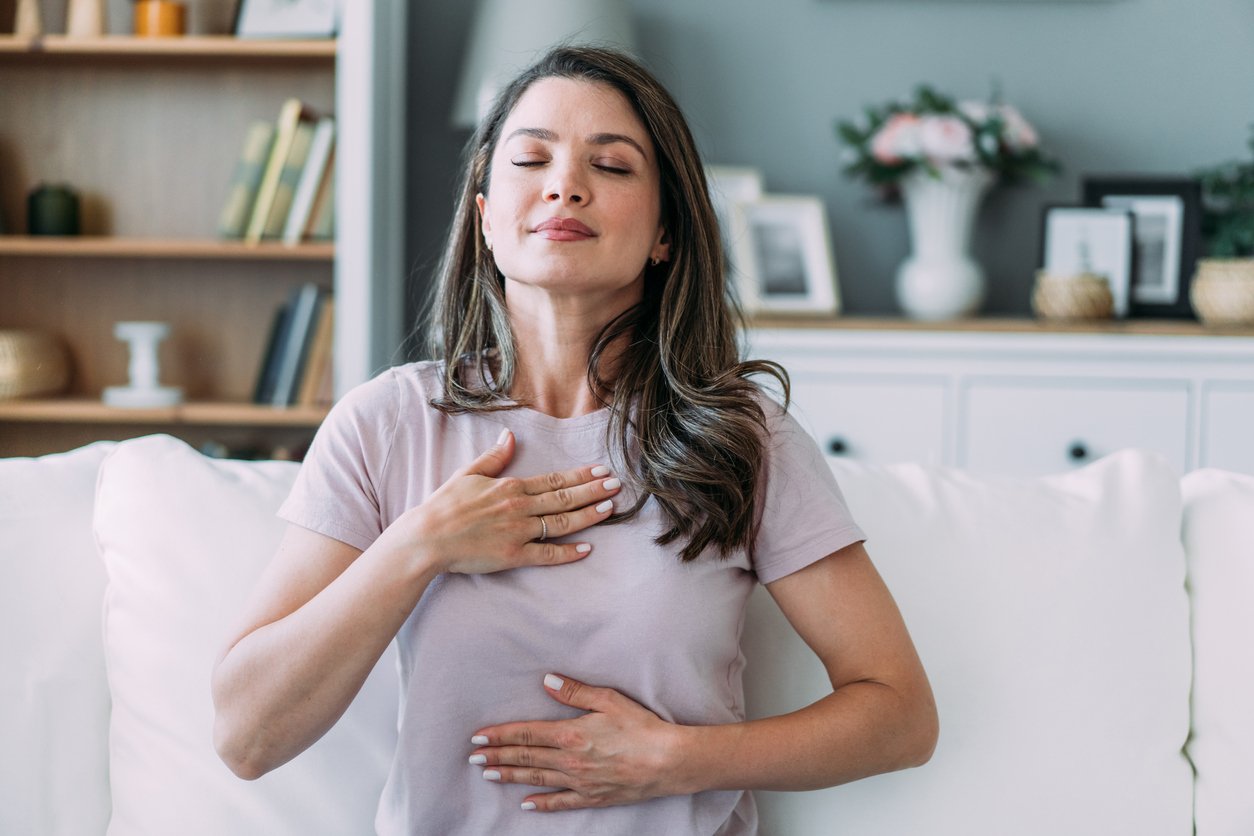
Sit or lie in a position that feels supported. Let the breath come in naturally. As you breathe out, let the exhale be a little slower and softer than usual, like a quiet sigh. There’s no need to force it. A slightly longer out-breath is enough. Continue for a few rounds, then let the breath go back to its own pace.
Modification: Breathe through the mouth if the nose feels difficult, or simply notice the out-breath without changing it.
2. Simple breath counting
Breathe naturally and silently count each out-breath, from one up to five, then start again. If you lose count, as almost everyone does, simply begin again. The counting is just a soft anchor for the mind.
Modification: If counting feels frustrating, try silently saying “in” and “out” instead.
3. A short body scan
Bring your attention to your feet, then slowly move it upwards through your legs, hips, belly, chest, shoulders, arms, neck and face. Notice what’s there, such as warmth, tension or tingling, without trying to change anything. If you reach an area that feels uncomfortable to focus on, move past it.
Modification: If the body scan feels like too much, keep your attention outside the body instead, on the weight of your hands resting on your lap, the support of the chair beneath you, or one steady sound in the room.
Using breath awareness in difficult moments
One of the most practical uses of breath awareness is as a pause. When stress, overwhelm or an urge arises, there’s often an instinct to act on it immediately. Turning attention to a few natural breaths can create a small gap between the feeling and what comes next.
That gap won’t always be enough, and that’s fine.
Where yoga fits, and where it doesn’t
To be completely clear: these practices do not manage acute withdrawal, which can be medically serious, and they’re not a substitute for professional treatment. Anyone considering stopping, or struggling in recovery, should speak to a doctor or addiction professional.
Where breath work and yoga can help is as a complement to that care. Some treatment services include mindfulness or movement within their programmes, and most work as a staged pathway, from detox and residential care through to outpatient support, as one Texas treatment programme sets out. It’s worth asking any service what’s offered, and whether practices like these can continue once formal treatment ends.
Safety notes
A few points to keep in mind:
- Avoid forceful or rapid breathing techniques, especially as a beginner
- Never hold the breath or push it to a strict rhythm
- Stop or return to natural breathing if you feel dizzy, anxious or uncomfortable
- Tell your doctor or care team about any practice you’re using
If you’re struggling or have thoughts of harming yourself, please reach out straight away. In the UK and Ireland, Samaritans can be reached free on 116 123, 24 hours a day, and in an emergency call 999 or 112. In the US, call or text 988 to reach the Suicide and Crisis Lifeline. In Canada, call or text 9-8-8 for the Suicide Crisis Helpline.
A breath you can take with you
A slower out-breath won’t change everything early recovery asks of people. But it belongs to you, it can be practised anywhere, and it’s always there to come back to.
Sources
- National Center for Complementary and Integrative Health. Yoga for Health (eBook, updated August 2024). https://files.nccih.nih.gov/yoga-ebook-2024-01-508.pdf
- Samaritans Ireland. About us (helpline 116 123, free, 24/7; checked October 2026). https://www.samaritans.org/samaritans-ireland/about/
- 988 Suicide Crisis Helpline, Canada (call or text 9-8-8, 24/7; listing checked October 2026). https://pe.211.ca/result/988-suicide-crisis-helpline–87590905
- Bowen, S., Witkiewitz, K., Clifasefi, S. L. et al. (2014). Relative efficacy of mindfulness-based relapse prevention, standard relapse prevention, and treatment as usual for substance use disorders: a randomized clinical trial. JAMA Psychiatry (published online 19 March 2014). https://doi.org/10.1001/jamapsychiatry.2013.4546
- Goldberg, S. B., Pace, B., Griskaitis, M. et al. (2021). Mindfulness-based interventions for substance use disorders. Cochrane Database of Systematic Reviews, Issue 10, CD011723. https://doi.org/10.1002/14651858.CD011723.pub2
- Cenikor. Corpus Christi (client page; read October 2026). https://www.cenikor.org/locations/corpus-christi-texas/