Overthinking at Night? 5 Yoga Poses That Calm Anxiety Fast
Overthinking at night is not a mindset problem.
It is a nervous system state.
When the body remains in sympathetic dominance – alert, scanning, problem-solving – the brain continues generating thought loops long after the day has ended.
Anxiety before sleep is rarely about lack of fatigue.
It is about lack of down-regulation.
From a physiological perspective, calming anxiety requires shifting neural tone away from hyperarousal and toward parasympathetic regulation. This involves:
- Slowing respiratory rate
- Reducing heart rate variability instability
- Decreasing cortical stimulation
- Lowering muscular guarding
- Increasing vagal tone
The following five poses are not selected for intensity or flexibility.
They are selected for their direct influence on autonomic balance and neural safety signaling.
What Is Happening During Nighttime Overthinking?
At night, external stimulation decreases. But if the nervous system remains activated, internal stimulation increases.
This often includes:
- Elevated sympathetic tone
• Shallow breathing patterns
• Increased jaw and pelvic floor tension
• Heightened limbic system activity
• Reduced parasympathetic buffering
In simple terms, the body still thinks it needs to stay alert.
The poses below help interrupt that loop by changing breathing mechanics, body position, and sensory feedback, all of which directly influence anxiety physiology.
1. Legs Up the Wall (Viparita Karani)
Legs Up the Wall is one of the fastest ways to influence autonomic tone.
Elevating the legs above the heart alters pressure receptor feedback (baroreceptors), which encourages a reflexive decrease in heart rate and sympathetic drive.
Neurological & Kinesiological Effects
- Enhances venous return
• Reduces gravitational stress on lower limbs
• Encourages passive diaphragmatic breathing
• Increases vagal signaling
• Lowers physiological vigilance
Why It Calms Anxiety Fast
Anxiety thrives in upright, ready-to-act positions.
This posture removes effort from the system and communicates safety through passive support.
Stay 3–8 minutes with slow nasal breathing.
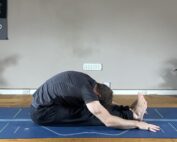
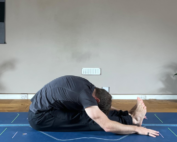
2. Child’s Pose (Balasana)
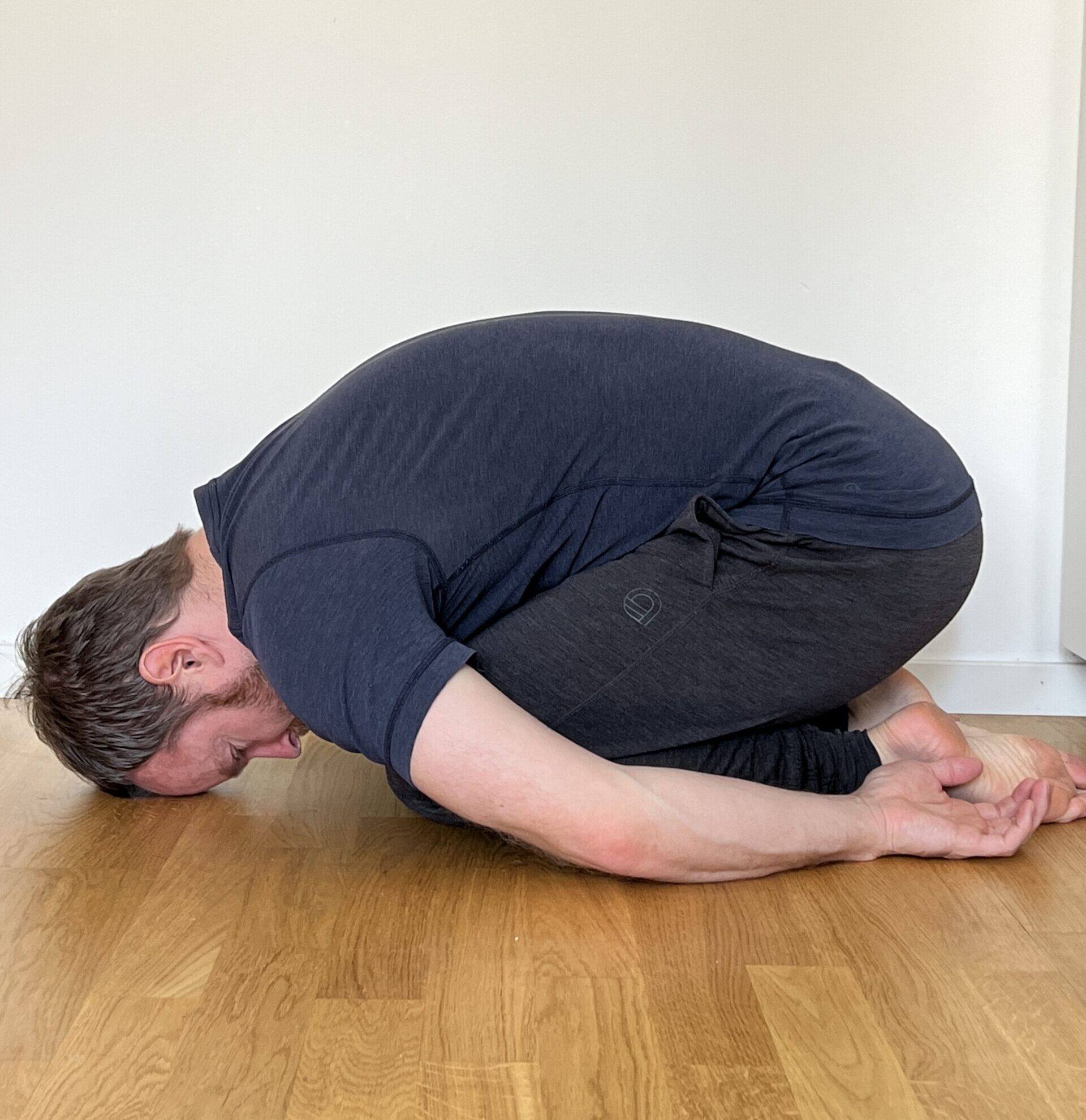
Child’s Pose places the body in flexion – a protective, contained position the nervous system recognizes as safe.
Spinal flexion reduces extensor tone, which is closely linked to alertness and readiness.
Nervous System Effects
- Decreases spinal extensor activation
• Encourages posterior chain release
• Compresses abdomen for improved diaphragmatic feedback
• Reduces visual stimulation
• Increases parasympathetic activation
Why It Reduces Overthinking
Flexion postures provide quiet cortical stimulation and decrease external orientation.
The mind follows the body’s cue to withdraw and soften.
Remain 1–3 minutes with forehead supported.
3. Supine Twist (Supta Matsyendrasana)
Twisting while fully supported influences both spinal tension and visceral regulation.
Anxiety often presents as thoracic stiffness and restricted breathing. Supine twists gently decompress these areas without activating effort.
Kinesiological Breakdown
- Mobilizes thoracolumbar junction
• Improves rib cage excursion
• Stimulates abdominal organs
• Reduces protective muscular guarding
Why It Calms Mental Agitation
When rib mobility improves, breath depth increases.
When breath depth increases, neural tone shifts.
Stay 1–2 minutes per side with relaxed breathing.
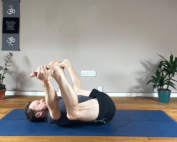
4. Happy Baby Pose (Ananda Balasana)
Anxiety frequently shows up in the pelvis, jaw, and sacrum.
Happy Baby gently decompresses the sacral region while providing soothing vestibular input if lightly rocked.
Neuromuscular Effects
- Decompresses lower lumbar spine
• Reduces sacral tension
• Releases adductors
• Softens jaw reflexively
• Encourages parasympathetic dominance
Why It Interrupts Anxiety Patterns
The sacrum plays a role in pelvic autonomic signaling.
Releasing this area reduces unconscious guarding patterns that maintain hypervigilance.
Stay 1–2 minutes.
5. Corpse Pose (Savasana)

Savasana is neurological training.
The goal is not sleep.
The goal is conscious disengagement of muscular effort.
Nervous System Effects
- Decreases cortical arousal
• Reduces motor neuron firing
• Lowers brainwave frequency
• Supports vagal tone increase
• Encourages interoceptive awareness
Why It Calms Anxiety
Anxiety is sustained by unconscious muscular contraction and cognitive vigilance.
Savasana retrains the body to release both.
Stay 5 minutes minimum.
Key Principles for Calming Anxiety at Night
Less stimulation.
More support.
Anxiety reduction through yoga is not about intensity. It is about safety signaling.
Follow these principles:
- Move slowly
- Breathe through the nose
- Lengthen the exhale
- Support the head and spine
- Avoid strong stretches late at night
Breath precedes shape.
Regulation precedes relaxation.
How Long Should You Practice?
Even 10–12 minutes is effective.
Example sequence:
- Legs Up the Wall – 5 minutes
- Child’s Pose – 2 minutes
- Supine Twist – 2 minutes
- Savasana – 5 minutes
Consistency reshapes neural pathways.
Anxiety is a learned physiological state.
Calm can also be learned.
When to Use These Poses
- During racing thoughts before bed
- After emotionally intense days
- During stress spikes
- As part of a wind-down routine
- During periods of chronic overthinking
The nervous system responds to repetition, not force.
Contraindications and Cautions
- Avoid stimulating backbends late at night
- Skip strong standing flows before bed
- Modify any posture causing strain
- Do not hold breath
- If anxiety increases, return to simple nasal breathing
The goal is regulation – not achievement.
Final Thoughts
Overthinking at night is not weakness.
It is dysregulated physiology.
These five poses calm anxiety fast because they change body position, breathing mechanics, and neural feedback – the foundations of autonomic balance.
Each posture communicates:
You are supported.
You are safe.
There is no action required.
Over time, consistent signaling reduces baseline anxiety and shortens the time it takes to transition into rest.
Yoga, when understood through movement science, becomes a tool for nervous system literacy.
It teaches the body how to stand down.
Ready to move beyond shapes and into physiology?
Join me inside my online classes on Patreon or explore deeper, nervous-system-informed practice through the DJY Mentorship Program, where we train regulation, not just flexibility.