Skip to content

How to Practice Extended Trikonasana (Utthita Trikonasana) with Strength, Stability, and Awareness
By Dav Jones, Senior Yoga Teacher and Teacher Trainer
From a kinesiologist’s lens, Extended Trikonasana (Utthita Trikonasana) is a dynamic interplay of lateral stability, fascial tension, and breath-driven expansion. This iconic posture is more than a side bend; it’s a highly integrated movement that coordinates hip mechanics, spinal alignment, rib mobility, and neuromuscular control.
Extended Trikonasana becomes a full-body movement laboratory, teaching you how to stabilize through the legs while lengthening through the ribs, how to breathe into lateral space without collapsing through the spine, and how to create expansion without sacrificing structural integrity.
Let’s explore how this seemingly simple posture becomes a sophisticated practice in mobility, awareness, and functional strength.
What Is Extended Trikonasana (Utthita Trikonasana)
In Sanskrit, Utthita means “extended,” Tri means “three,” and Kona means “angle.”
Extended Trikonasana creates a three-point geometric shape involving the legs, spine, and arms.
Biomechanically, it sits at the intersection of:
- lateral spinal flexion
- thoracic rotation
- hip abduction and external rotation
- grounded foot mechanics
fascial extension through the side body
Benefits of Extended Trikonasana (Utthita Trikonasana)
Physical Benefits (From a Movement Science Perspective)
Lateral Chain Lengthening
Targets the obliques, quadratus lumborum, intercostals, serratus anterior, and latissimus dorsi – improving trunk mobility and breath capacity.
Hip Stability & Mobility
- Front hip externally rotates and flexes
- Back hip abducts and stabilizes
This improves pelvic integrity and lower-body coordination.
Functional Leg Strength
Front leg: adductors and hamstrings lengthen under load and quadriceps shorten.
Back leg: glute medius, hamstrings, and deep rotators create grounding forces.
Spinal Organization
Encourages axial elongation and controlled lateral flexion, reducing lumbar compression and promoting healthy thoracic movement.
Fascial Continuity
Strengthens the lateral fascial line from outer foot → hip → ribs → underarm → arm.
Neural & Energetic Benefits
Proprioceptive Precision
Balancing lateral flexion while grounding through both feet enhances joint receptor feedback, especially at the hips, knees, and ankles.
Breath-Body Coordination
The side ribs on the topside expand on the inhale, improving lateral ribcage expansion and aiding in mobility.
The exhale supports the obliques and stabilizers to maintain spinal integrity..
This rhythmic expansion–containment pattern builds breath intelligence.
Grounded Mental Clarity
The wide stance and structural alignment reduce sympathetic tension and increase parasympathetic grounding – promoting steadiness.
Energetic Alignment
Trikonasana harmonizes:
- Apana Vayu (downward stability through the legs)
- Udana Vayu (upward lift through the spine)
This dual flow creates expansion without collapse.
Step-by-Step Guide to Performing Extended Trikonasana (Utthita Trikonasana)
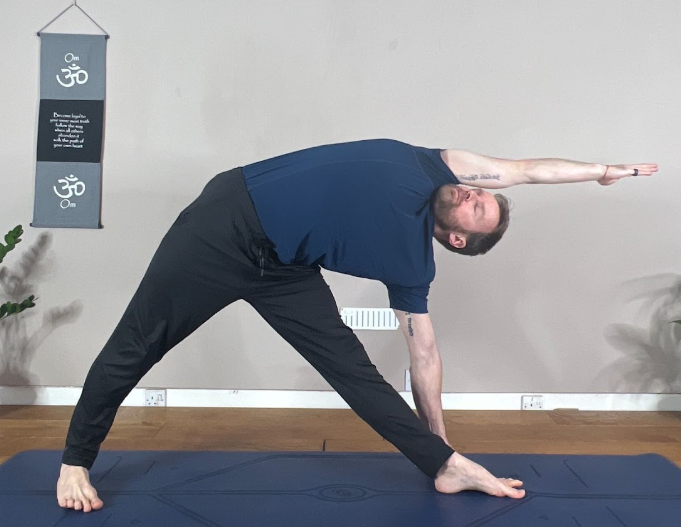
1. Establish Your Footing
From standing, step the feet wide.
- Turn your rear foot inwards so the thigh bone internally rotates
- Press down through the mound of the big-toe and outer heel.
- Keep legs straight but not locked
In the front foot press firmly through:
- mound of big toe
- outer heel
Why this matters:
Ground reaction forces stimulate glute activation and provide a stable base for lateral flexion.
2. Organize the Pelvis
Draw your right hip crease back as the left thigh rotates slightly inward.
- Explore the rotations through both hips to where you notice space in your pelvis and lower back. If by doing this no space is accessed – then change the position of the feet until it does.
Functional cue:
Your pelvis is the bridge between legs and spine – keep it centered to prevent lumbar compression.
3. Lengthen the Spine (Axial Extension)
Before tipping sideways, reach the torso long.
- Lift from sacrum to skull
- Keep bottom ribs lifted and elongated before you laterally side bend
- Maintain neutral lumbar curve
Why this matters:
Axial extension protects the lower back and prepares the spine for controlled lateral flexion.
4. Enter the Side Stretch
- Laterally flex the spine towards your front thigh, keep your top ribs open.
- Reach your right hand forward and rotate the shoulder externally wrapping your tricep
- Lower it to shin, block, or floor
Functional cue:
The movement originates at the hip joint – not by collapsing the ribs.
5. Integrate the Shoulder
- Shoulder blades upwardly rotate
- Serratus anterior activates with the shoulder blades protracting
Why this matters:
Prevents impingement of the supraspinatus tendon and stabilizes the shoulder girdle.
6. Create Lateral Expansion
On each inhale:
- widen the ribs
- expand the intercostals
- lengthen through the side waist
On each exhale:
- engage obliques
- stabilize pelvis
- root through both feet
This repetitive breath pattern enhances neuromuscular control.
7. Hold and Refine
Stay for 5–8 breaths.
Observe:
- How the legs stabilize
- How the ribs open
- How the core organizes
- How the breath guides subtle alignment shifts
Micro-adjustments train joint receptors and improve structural awareness.
8. Release with Control
Press down through the feet, and bend more through the front knee.
Inhale to rise back to standing.
Repeat on the opposite side.
Modifications and Props (From a Functional Lens)
Tight Hamstrings?
Place your lower hand on a block to avoid spinal collapse.
Limited Hip Mobility?
Shorten the stance and focus on pelvic organization.
Balance Challenges?
Practice with your back against a wall.
Lower Back Sensitivity?
Bend the front knee slightly to reduce tension on the QL and hamstrings.
Neck Tension?
Keep gaze neutral or downward.
Variations for Progressive Loading
1. Extended Triangle With Overhead Reach
Reaches top arm overhead, increasing the load on the lateral chain and obliques.
2. Bound Extended Triangle
Adds internal rotation and shoulder mobility.
3. Revolved Triangle (Parivrtta Trikonasana)
Shifts the movement into rotation, challenging core control and hip stability.
Kinesiological Keys for Practicing Extended Trikonasana (Utthita Trikonasana)
| Principle | Application in Pose | Why It Matters |
| Ground Reaction Force | Press evenly through both feet | Improves hip stability and kinetic chain integration |
| Eccentric Control | Front adductors and hamstrings lengthen under load | Prevents strain and builds mobility |
| Core Bracing | Obliques + transverse abdominis active | Protects lumbar spine and enhances breath control |
| Spinal Elongation | Axial lift maintained throughout | Prevents side-body collapse |
| Fascial Continuity | Feel stretch from outer heel → hip → ribs → arm | Enhances mobility and energetic flow |
When to Include Extended Trikonasana (Utthita Trikonasana) in Your Practice
- Pre-flow activation: Awakens side body and hip mechanics
- Mid-flow: Balances strength with expansion
- Postural correction: Improves spinal alignment and rib mobility
- Functional training: Enhances gait mechanics and pelvic stability
- Mind–body integration: Deepens breath awareness and proprioception
Contraindications and Cautions
Knee Sensitivity:
Keep micro-bend in the knee; avoid locking.
SI Joint Irritation:
Avoid forcing pelvis to square. Allow natural rotation.
Lower Back Pain:
Focus on hip hinge rather than lateral collapse.
Hamstring Strain:
Use a block; shorten the stance.
Pregnancy:
Use support and avoid deep compression.
Final Thoughts
From a movement science perspective, Extended Trikonasana (Utthita Trikonasana) is a full-body integration – a posture where force, breath, and structural alignment meet. It teaches us that mobility isn’t passive stretching but controlled expansion supported by stability.
When practiced with breath awareness and intelligent alignment, Extended Trikonasana becomes a neuromuscular conversation – a harmonization of grounding and lift, strength and openness, precision and spaciousness.
Ready to build stronger movement awareness?
Join my online classes on Patreon or explore 1:1 mentorship in the DJY Mentorship Program – where biomechanics meets embodied yoga.