Skip to content

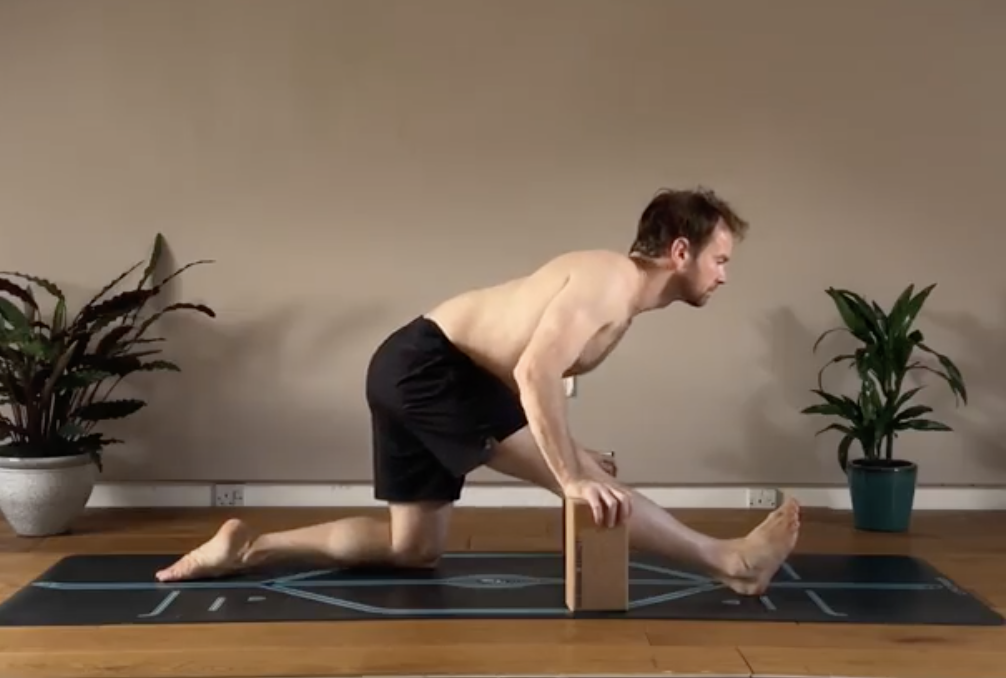
How to Practice Ardha Hanumanasana (Half Splits Pose) with Strength, Stability, and Awareness
By Dav Jones, Senior Yoga Teacher and Teacher Trainer
From a kinesiologist’s lens, Ardha Hanumanasana is one of the most misunderstood poses in modern yoga. It’s often treated as a passive hamstring stretch – something you sink into, tolerate, and breathe through until it’s over.
But in reality, Ardha Hanumanasana is a precision-based movement drill.
It reveals how you load your hamstrings, how your pelvis organizes under tension, how your nervous system responds to stretch, and whether your flexibility is supported by strength – or just borrowed from joint range.
When practiced with intention, Half Splits becomes a place where mobility, control, and awareness meet. When rushed or forced, it becomes a shortcut to irritation, guarding, or strain.
Let’s slow this pose down and explore what it’s actually teaching.
What Is Ardha Hanumanasana?
In Sanskrit, Ardha means “half,” Hanuman symbolizes devotion and the legendary leap, and asana means “posture.” While it’s commonly described as “Half Splits,” this translation misses the nuance.
Ardha Hanumanasana isn’t a preparation pose.
It’s a standalone posture that asks your body to manage length under load.
Biomechanically, it lives at the intersection of:
- Hip flexion
- Knee extension
- Ankle dorsiflexion
- Pelvic containment
- Spinal organization
The front leg’s hamstrings are lengthening eccentrically (under tension), while the pelvis must remain stable enough to prevent the spine from compensating. This balance – between yielding and supporting – is what makes the pose powerful.
Why Ardha Hanumanasana Is Harder Than It Looks
Unlike dynamic poses, Half Splits removes momentum.
There’s nowhere to hide.
- Tight hamstrings can’t be bypassed by speed
- Nervous system resistance becomes obvious
This pose exposes:
- Asymmetries between sides
- Habitual pelvic dumping
- Overstretching tendencies
- Fear-based guarding
Benefits of Ardha Hanumanasana
Physical Benefits (Movement Science Perspective)
- Hamstring Strength at Length
Ardha Hanumanasana trains the hamstrings to tolerate load in a lengthened position. This is essential for:
- Injury prevention
- Running mechanics
- Deadlifts and hinges
- Everyday walking and bending
Flexibility without strength is fragile. This pose builds both.
- Pelvic Control & Awareness
The posture teaches you to differentiate between:
- Hip flexion
- Posterior pelvic tilt
- Lumbar flexion
Instead of collapsing the pelvis to “go deeper,” you learn to maintain containment while lengthening.
- Knee Joint Safety
By refining terminal knee extension with awareness, Half Splits helps prevent hyperextension and ligament strain – especially for hypermobile practitioners. - Ankle & Calf Mobility
Dorsiflexing the front ankle lengthens the calf complex, supporting gait efficiency and reducing compensatory patterns up the chain. - Fascial Integration
The superficial back line – from the sole of the foot through the calves, hamstrings, sacrum, and spinal fascia – is gently but intelligently loaded.
Neural & Energetic Benefits
Proprioceptive Refinement
Slow holds increase joint receptor feedback, particularly in the knee and hip. This enhances movement intelligence, not just range.
Nervous System Regulation
When approached gradually, Ardha Hanumanasana down-regulates threat responses. The body learns that stretch does not equal danger.
Energetic Grounding
Apana vayu is emphasized through the rooted back knee and heel, while subtle spinal lift prevents energetic collapse or dissociation.
This is grounding without heaviness. Expansion without escape.
Step-by-Step Guide to Ardha Hanumanasana
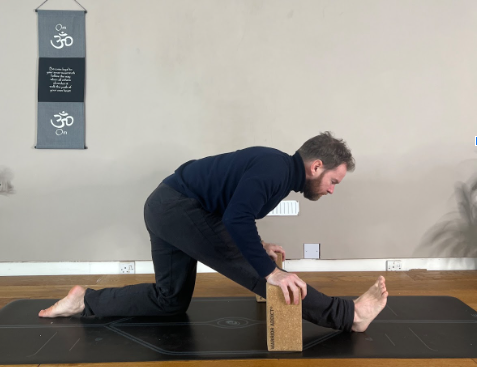
1. Enter with Intention
Start in a low lunge with the right foot forward and the back knee down.
Pause.
Notice how your weight is distributed.
2. Shift Back Slowly
Walk the front foot slightly forward and begin to shift your hips back.
- Keep the pelvis heavy but organized – Isometrically pull your front-hip back and your rear-hip forward
- Let the movement come from the hip hinge, not spinal collapse
3. Organize the Front Leg
Extend the front knee gradually.
- Keep a micro-bend if needed
- Flex the foot and draw the toes back
Lightly press the heel into the mat to activate the hamstrings before stretching them.
4. Pelvic Containment Over Depth
Draw the front hip crease back slightly.
Instead, aim for balanced tension between both sides.
5. Lengthen the Spine
Inhale and lift through the chest and crown.
- Create axial extension
- Maintain neutral spinal curves
Only hinge forward if you can keep length through the spine.
6. Hands as Regulators
Place hands on blocks or the mat.
Use them to:
- Regulate depth
- Maintain balance
- Reduce nervous system threat
Not to pull yourself forward.
7. Breathe with Precision
Stay for 5 – 10 slow breaths.
- Inhale: create length and spaciousness
- Exhale: soften resistance without forcing release
8. Exit with Control
Bend the front knee slightly.
Shift forward into a lunge before switching sides.
Common Compensation Patterns
- Locked Knee with No Hamstring Support
- Overstretching Through Pain or Numbness
These are signs to back off – not push further.
Modifications and Prop Support
Tight Hamstrings
- Bend the front knee
- Elevate hands on blocks
- Stay upright
Sensitive Knees
- Pad the back knee generously
- Practice with back toes tucked
Lower Back Sensitivity
- Keep torso more vertical
- Focus on hip hinge mechanics
Variations for Progressive Loading
1. Active Ardha Hanumanasana
Press the front heel into the mat and isometrically drag it back.
Builds strength where flexibility usually steals.
2. Breath-Led Waves
Inhale to lengthen.
Exhale to hinge slightly deeper.
Improves neuromuscular coordination.
3. Lunge-to-Half-Splits Transitions
Slow, controlled transitions enhance tendon resilience and joint confidence.
Kinesiological Keys
| Principle | Application | Why It Matters |
| Eccentric Control | Hamstrings lengthen under load | Injury prevention |
| Pelvic Containment | Neutral pelvis | Lumbar safety |
| Ground Reaction | Heel presses down | Posterior chain awareness |
| Axial Extension | Spine lifts before folding | Structural integrity |
| Fascial Continuity | Foot-to-spine awareness | Whole-body integration |
When to Include Ardha Hanumanasana
- Early in practice for mindful mobility
- Post-flow for nervous system settling
- On recovery days
- For athletes needing hamstring resilience
Contraindications and Cautions
- Hamstring tears or tendinopathy
- Sciatic nerve irritation
- Hypermobility without strength
In these cases, less depth and more control is essential.
Final Thoughts
Ardha Hanumanasana is not about how far you fold.
It’s about how intelligently you manage tension.
This pose teaches patience, restraint, and respect for your nervous system. It reminds us that real flexibility is earned – not taken.
When practiced with integrity, Half Splits becomes a conversation between strength and softness, grounding and expansion, effort and surrender.
Ready to build smarter mobility and embodied strength?
Join my online classes on Patreon or explore 1:1 mentorship in the DJY Mentorship Program – where biomechanics meets embodied yoga.